Tuesday, 15 June 2021

Blogjune Day 15 - Scoping the field

I'm never not keeping an eye on job ads on a semi-regular basis.

That's not to say that I'm actively job-hunting - I'm really not. But I find it useful to keep an eye on what is out there, and how the job market is constantly changing for somebody with my skills and experience.

I even apply for them once in a while - often I'm genuinely interested in the role, and want to gauge how far I can get into the the application process, and if I get to sit across the table from somebody who I admire and try to make an impression on them. I'm regularly developing new skills, and I'm often curious to see what new doors they might open.

And in terms of keeping track of where the sector is going, it's also a very useful exercise in working out where the demand is changing, and where I need to develop new skills and experience. From time to time, I'll see a job and think 'yeah, that'd be a cool job to do in a few years... but first I need to get some experience doing X, Y and Z.' Hopefully, in a few years' time, those skills will still be in demand.

I do worry, though, that by trying to think 2-3 jobs down the track, I get distracted from feeling content in any given job that I'm doing at the time. When I think back to the last few roles that I was in, they came up at a time when I wasn't actively job-hunting... it was more that they were interesting opportunities that I thought I'd give a shot. But I've now reached the point where I haven't stayed in the one same position for more than about 15-18 months. In fact, I think I'm probably at a new personal record for staying in the same job - just on 17 months to the day!

I think what helps is to have a role where you can do a whole lot of different things. This was definitely the case in my previous roles at the NLA, where there were many secondment and temporary promotion opportunities, and lots of very different roles across the library. And right now, I have a lot of creative freedom to try new things, and explore different aspects of the library sector.

But still - it's good to keep at least half an eye on the horizon, and keep track of the different opportunities that are still out there. Like Hamilton, there are still a million things I haven't done...

Monday, 14 June 2021

Blogjune Day 14 - Canberra birdlife

One of the first things I noticed about moving to Canberra, almost five years ago now, is the birds. Where, in my previous place in the inner West of Sydney, I'd be woken up by the first flight out of Sydney airport, I'd now be woken by the birds. If I were lucky, it would be the soft warbling of magpies or currawongs. In my current apartment, the nearby conifers are more inclined to attract swarms of sulfur-crested cockatoos or corellas.

From waking up, to getting on my bike for the 20-minute commute to work, here's a list of the different kinds of birds that I might spot on any given morning.

Sulfur-crested cockatoos - the screechy ones.
These are terrifying if you're not expecting them, and can act as an effective morning alarm clock. As a kid, there was a guy who'd hang out out the front of the local supermarket with one of these guys on his shoulder, and had been trained to repeat, 'Hello cocky' if you greeted it with these words. I'm much happier to see flocks of the less domesticated variety these days.

Corellas - also screechy, but with blue eyes. Whilst they are almost as noisy as the sulfur-crested cockatoo, I had never seen these birds before moving to Canberra.


Galahs - not as noisy as you'd think. Galahs have a bad rep, thanks to Alf from Home and Away, but on closer inspection, they are much more charming as the aforementioned native Australian birds. They're more inclined to chirp than squawk (with the exception of their young, which are more reminiscint of a bad Bob Hawke impersonation).


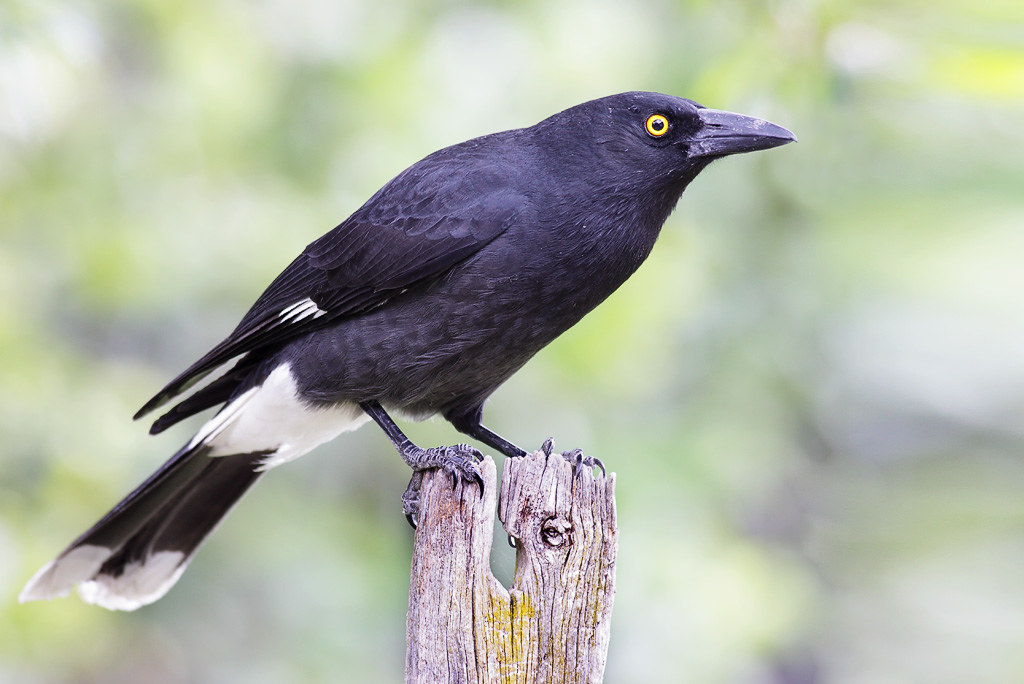
Currawongs - avian predators. I occasionally see these on the balcony, and their big beaks terrify me. And it turns out that I'm not entirely unjustified - they've been known to feed on small birds. And cycling through the city around dusk, you can see them all lined up along the tops of the buildings, calling to and fro. It's a beautiful sound, but also possibly marking the advent of a Hitchcock-esque bird apocalypse.


White-winged choughs - demonic foragers. It's not uncommon to see groups of these birds scratching around patches of lawn or parkland, and their red eyes, curved beaks and haunting calls are like something that's emerged from the depths of hell.


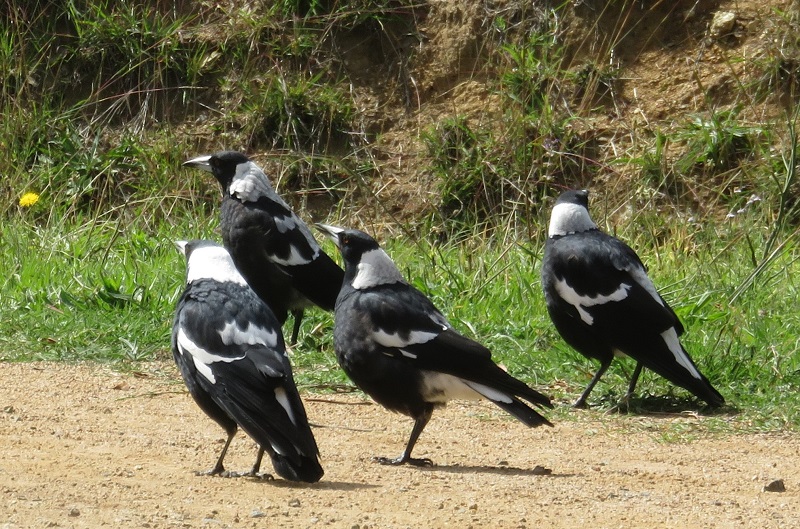
Magpies - savage swoopers. As we approach late winter, I'm starting to keep an eye on the MagpieAlert website, because come August, swooping season starts. Last year, I had to completely change my cycling route to work. I don't even bother with cable-ties or googly eyes on my helmet. They don't work.


Gang gang cockatoos - the fancy ones
s.
I only see these once in a while, but when I do it always feels like a special occasion.

I could go on... special mentions include superb fairy wrens, grass parrots, king parrots, and the occasional yellow-tailed black cockatoo. Whatever I spot each morning, it makes for a pleasant start to the day.

Sunday, 13 June 2021

Blogjune Day 13 - life is a cabaret

As established, I love musicals. I also love cabaret. "What is cabaret, and how is it still a thing," I hear you ask.

Many are familiar with the Kander and Ebb musical, adapted into a film in 1972 starring Liza Minelli, Joel Gray and that guy who was in Logan's Run. People get up in a poky little 1930s Berlin Club and sing songs that make commentary on society and their lives.

Beyond that, I become familiar with the modern concept of cabaret when I attended Eddie Perfect's show 'Angry Eddie' in Duckboard House at the Melbourne Comedy Festival in 2004, which soon led me to find other up and coming stars, such as Tim Minchin, Sammy J, Yana Alana, Reuben Krum, Geraldine Quinn and the rotating program of shows at the Butterfly House. Of course, I'd associate these acts with other similar musical comedy acts, such as Tripod and the Doug Anthony All Stars.

So, cabaret = musical comedy, right? Some might say that it's a question of semantics. But one thing that I strongly associate with cabaret is an element of social commentary - usually through parody or satire - and a small performance space, sometimes up close with the performer, with no real chance of escape until the curtain closes.

Take Bo Burnham, for example - somebody whose work I've followed for over ten years now, and is a solid musical comedian, whose uses his edginess in both progressive and problematic directions.

I sat down and watched his recent 'Netflix comedy special', expecting another hour of standup and musical comedy schtick. But this was something else.

His first solo performance in around five years, this was written, performed and edited by Burnham over the past year, and takes place in one room. The premise - he's in lockdown and he's trying to write and record a show for you, the audience. Right from the outset, he's almost resentful of having to do this, and satisfy his unknown online audience saying, 'Here's some content', and then reflecting on how messed-up the world is, and yet here he is trying to succeed by making jokes, and sarcastically sets out to 'heal the world with comedy'. The problem is that he's a privileged white guy - something that he's quite conscious of, and appears to be constantly attempting to make amends for his problematic past, but self-sabotages his attempts to do so because, as he knows, it's a self-indulgent medium that just serves to continue to centre himself on the world's problems.

It's an hour and a half of continuous spiraling into further self-doubt, stubborn persistence and depression, as his hair and beard grows longer. It's no longer an exercise in 'musical comedy', but severe self-analysis and self-deprecation in the context of an increasingly unjust and online society. And, as the audience, we're right there with him, in that small room, as he slowly sinks to an 'ATL' (all-time low - not Atlanta).

This show had a profound affect on me, both as I watched it, and afterwards, considering myself as an artist, as an audience member, thinking about how I choose to exist in the world, how I relate to technology and our current online society - and how this all affects our mental health, especially during a pandemic.

And despite the recorded, online nature of this show, it feels like a cabaret in its most raw form - intimate - claustrophobic, even - personal, political... and in a small room with songs.

(That aside, I'm soon heading to interstate for the Adelaide Cabaret Festival, for a very different experience - one full of large spaces with live performance. I am very excited for this.)

Saturday, 12 June 2021

Blogjune Day 12 - Lights up on Washington Heights...

Last night, I went to a special preview screening of In the Heights - the film adaptation of Lin Manuel Miranda's first Broadway musical which won four Tony Awards in 2008.

It's been a long time coming, with the cinematic release delayed a year due to COVID-19. You can watch the opening number below...


So, what did I think of it?

There's always a lot of risk when it comes to adapting a hit Broadway musical to film, from Les Miserables to Cats. Incidentally both of those films was directed by Tom Hooper - one was epic and yet forgettable, and the other you can never unsee.

The first thing to know about In the Heights is that this is an adaptation - not a frame-for-frame remake. Which makes sense, since film is a completely different medium to stage. The big scenes are so much bigger, and the intimate scenes are much more nuanced. This film takes every opportunity to make the most of the medium - from the huge elaborate dance scenes filmed on location, to scenes in Abuela Claudia's kitchen, where you could almost smell every delicious dish being cooked.

As an adaptation, things have changed. Characters are fleshed out, and the sequence of events have changed. Some songs and plotlines are cut, whilst other more timely issues, such as racism and immigration, are more prominent. This felt like an organic progression to the work, perhaps cutting some of the weaker elements of the source material, and taking the opportunity to bring more depth and meaning to the characters and the film's ending.

And yes, they changed the ending. To be honest, I think it works so much better - as touching and emotional as the stage version's ending is, this brings a sense of joy and closure to the suenito (little dream) of the central characters.

The cast is an absolutely joy to watch. Anthony Ramos is a star as Usnavi - perhaps a bit too cool and charismatic compared to the passionate-yet-awkward energy that Lin Manuel Miranda brought in originating the role, but still very fitting in the role. Daphne Rubin-Vega - yes, that's Mimi from Rent - is phenominal as Daniela, as is Olga Merediz, who originated the role of Abuela Claudia and whose song 'Paciencia Y Fe' is a haunting and memorable swan song. Jimmy Smits is surprisingly good as Kevin Rosario. And there's a whole supporting cast of young up and coming stars that you should keep an eye out for. Finally, yes, Lin Manuel Miranda and Christopher Jackson (the original Usnavi and Benny) both feature as rival street vendors. Be sure to stick around to the end of the credits.

Visually, this is where the film really shines. You might know the director John M. Chu for making Crazy Rich Asians,  but it's his work on the Step Up franchise that comes through with the block-party-scale dance routines. The dancing is big - and I thought I knew a bit about salsa dancing, but the scene in the salsa club takes it to the next level. It's energic, raw, authentic - and these people can move.

The soundtrack is also amazing. Before the film, there was a trailer for Dear Evan Hansen, which felt a little overproduced, with not-very-subtle autotuning. However, the sound is very well done here - with some very clever moments, such as the subito piano toward the climax of '96,000' using an underwater shot. And not even an inkling that any of the vocals had been manipulated. Every song is an absolute banger, and I came out of the cinema wanting to play the soundtrack straight away.

Anyway, as you can tell, I loved it. 

If you get a chance, go see it on the big screen, the way it was clearly meant to be seen.


Friday, 11 June 2021

Blogjune Day 11 - more on labels and diversity

In my last post, I reflected on the strengths and flaws of the Own Voices label in identifying diverse works created by those from the same diverse backgrounds.

We also talk quite a bit about diversity in the library sector - but I'm not so sure that we've reached a point where it's necessarily a meaningful and inclusive conversation.

In my mind, diversity is another catch-all term, which both defines and others all that is not the dominant and privileged status, ie white, non-Indigenous, male, heterosexual, cis-gendered, neurotypical, without disability, and so on. There's the danger that if we're not careful, we simply define our workforce into 'diverse' and 'not diverse', which runs the risk of excluding those that need more careful consideration.

For example, in recent years, I've seen a lot of resources put into recruiting, embedding and supporting Indigenous people in the workforce - which absolutely is important work. But I've rarely seen similar affirmative measures created for other minority demographics.

At the same time, given that the Australian librarian workforce is made up of 86% of women, you could be forgiven for thinking that gender diversity isn't an issue. That is, until you realise that there is still a wage gap where men are more representative in the higher income brackets. Whether this is because more men are on a higher wage, or more women are working part-time or casual, it still amounts to the fact that there are gender considerations that go beyond simple diversity statistics. Equity is also important.

Even sub-categories of diversity are problematic. The one that I always bring up is 'culturally and linguistically diverse' (or CALD), which in Australia is defined based on which country you were born in, and which language you speak at home. It's a measure that's left over from the days of the White Australia policy, and excludes many second- and third-generation migrants living in Australia, such as myself.

Other catch-all phrases, such as ATSI (Aboriginal and Torres Strait Islander), BAME (Black, Asian and Minority Ethnic - often used in the UK), BIPOC (Black, Indigenous and People of Color - often used in the US), and FNPOC (First Nations and People of Colour - increasingly used here in Australia), all serve a purpose in defining and drawing attention to underrepresented people, but we do need to avoid the temptation of stopping at that level.

I recently read a piece that criticised the 'Stop Asian Hate' campaign, because it focused too much on East Asian hate, and didn't do enough to create awareness on the experiences of South Asians who were subjected to Islamaphobic attacks.

These are all just examples, but they highlight the fact that words matter, and detail is important.

Ultimately, diversity is just a measure - an indication of how well you are representative of your community. Just as important, if not more so, is considering equity and inclusion. You may have the diversity statistics, but without implementing equity and inclusion measures, many of the existing systemic power imbalances will remain.

Thursday, 10 June 2021

Blogjune Day 10 - on #ownvoices writing

On Sunday 6 June, We Need Diverse Books announced that they were no longer using the #ownvoices hashtag, saying that the term 'become a “catch all” marketing term by the publishing industry', which as then been 'used to place diverse creators in uncomfortable and potentially unsafe situations'.

They have announced that, instead, they will 'use specific descriptions that authors use for themselves and their characters whenever possible (for example, “Korean American author,” or “autistic protagonist”).'

Personally, I first became familiar with the term 'own voices' in 2018 when Fremantle Press published the anthology Meet me at the intersection. Described as an anthology of Own Voices, containing diverse stories written and created by authors of the same diverse group - in this case, people who are Indigenous, people of colour, LGBTIQA, or living with disability.

It felt like an important term at the time - not only was important that we have diverse representation in the stories that we read, but that we provide opportunities for diverse creators to be creating these narratives based on their lived experiences. It was a way of raising these voices and perhaps distinguishing them from writers who perhaps use other peoples' lived experiences as a device for propelling their own creative work.

So, what's changed? I'm actually not that sure, to be honest. I suspect that this decision is, in part, due to the experiences of Becky Albertalli last year, where she was effectively forced to come out as bisexual after prolonged and intense scrutiny and criticism online. She appeals to the literary community: 'Can we all be a bit more careful when we engage in queer Ownvoices discourse? Can we remember that our carelessness in these discussions has caused real harm? And that the people we’re hurting rarely have my degree of privilege or industry power? Can we make space for those of us who are still discovering ourselves? Can we be a little more compassionate? Can we make this a little less awful for the next person?'

Furthermore, there is a danger with catch-all labels, whether it be Own Voices, or even 'diverse', is that it creates a false dichotomy where it becomes the be-all and end-all of what is good and acceptable. There are many white writers who have written awful works featuring people of colour - but there are also those who have researched, consulted and had people of colour as their first readers to help create authentic narratives in what have become excellent works. There are also Own Voices works that are unfortunately not great.

And then, there are those who would claim their work as Own Voices, where that claim is in itself somewhat dubious, and they rely own the label as a way of raising the profile of their own work instead of its individual merits.

Ultimately, whilst measuring diversity is a useful indicator, it's the specific elements that make the industry diverse that is valuable. So, yes, I'm very happy for us to be more specific in the ways that we celebrate cultural and literary works - all the more opportunity to identify those specific voices that are underrepresented and absent, and raise those voices into prominence.

Wednesday, 9 June 2021

Blogjune Day 9 - on library leadership

Back in April, I attended the ALIA Information Online In-Depth virtual event on Leadership. It was a stimulating session, that reminded me of a lot of the issues that we need to stay on top of in both the Australian library sector and the wider GLAMR sector.

One thing really struck me, during the first section featuring three leaders in the GLAMR sector, was that none of them were qualified professionals in their given field. David Fricker, Director-General of the National Archives of Australia, comes from a computer science background, Director of the Australian Museum comes from a marketing and communications background. Kate Torney, CEO State Library Victoria, comes from a journalism background. More notably, all of these leaders stepped into these roles without having previously work in the GLAMR sector. We've also seen similar trends in leadership appointments in some of our state and public libraries.

That's not to say that they are not capable leaders in each of their roles - they've all shown a long-standing track record of achievement, and as I've often said, a librarianship qualification is not the be-all and end-all of one's capbility to work in a library, nor should it be treated as a hurdle requirement to do so.

However, it does raise the question: is there a lack or reluctance of qualified librarians who are suitably experienced to step up into leadership positions in the Australian sector? Or is it just that leaders coming from other sectors are far more experienced and capable, and obvious choices when appointing leaders into these roles?

When I think back to some of the best and brightest emerging leaders that I'd met when I was starting out, 10-15 years ago, I'd say that at least half of those who I would have tipped as future library leaders have moved sectors or shifted roles, and no longer associate themselves with the library profession. Some have burnt out, or gone on to do bigger and better things in another sector that they find much more meaningful and rewarding.

There was a time when we used to look forward to that oft-predicted time when all the baby boomers would retire, opening up all kinds of leadership roles. In more recent years, many have bemoaned the lack of new leadership opportunities, due to a combination of said baby boomers delaying their retirement, and shrinking library staffing budgets.

But perhaps this isn't the biggest thing we need to worry about - the fact is that the cultural sector has always been a desirable and competitive option for employment, and there are many very capable professionals out there who are building up a track record of achievements, and would jump at the opportunity to take on the top job in a major library. And they're better at running libraries than the librarians.

So where does that leave the library and information profession?

My view: we need to adapt, and let the strengths of those who join us from beyond the sector be our strengths as a profession. We need to stop pigeon-holing ourselves and the people we work with, otherwise we limit our opportunities to grow professionally. We need to encourage our library professionals to get experience and build better skills outside the sector - experience and skills that they can hopefully bring back. And we need to be a sector that our past emerging leaders might want to come back to in the future.